Why Toxic Gas Analysis Matters in Fire Safety
Fire safety testing is not limited to evaluating flame spread, heat release, or smoke density. Toxic gases released during combustion can pose serious risks to human health, particularly in enclosed environments such as railway vehicles, ships, tunnels, and buildings.
Common hazardous combustion gases include carbon monoxide (CO), carbon dioxide (CO₂), hydrogen cyanide (HCN), and hydrogen chloride (HCl). Accurate identification and measurement of these gases are essential for understanding the potential toxicity of fire effluents.
Fourier Transform Infrared (FTIR) spectroscopy provides an effective solution for analysing multiple gas components during fire testing.
ISO 19702: The Key Standard for FTIR Gas Analysis
ISO 19702:2024, Sampling and analysis of toxic gases and vapours in fire effluents using Fourier Transform Infrared (FTIR) spectroscopy, establishes a standardised approach to measuring gaseous combustion products.
The standard addresses important aspects of FTIR measurement, including gas sampling, calibration, spectral analysis, and measurement quality.
FTIR technology identifies gases through their characteristic infrared absorption spectra, enabling the simultaneous analysis of multiple compounds.
Compared with conventional single-gas detection methods, FTIR offers several advantages:
- Multi-component detection: Analysis of various toxic and irritant gases within one measurement system.
- Continuous monitoring: Observation of gas concentration changes during combustion.
- Detailed analytical data: Quantitative information supporting fire toxicity research and material evaluation.
Reliable results depend on appropriate calibration, sampling conditions, and instrument configuration.
Applications in International Fire Testing Standards
FTIR gas analysis is relevant to several international fire safety testing frameworks.
EN 45545-2 — Railway Fire Safety
This standard establishes fire behaviour requirements for materials and components used in railway vehicles. Toxic gas analysis supports applicable smoke toxicity assessments, helping evaluate potential hazards in passenger compartments.
IMO 2010 FTP Code — Marine Fire Safety
Part 2 addresses smoke and toxicity testing for marine applications. Gas analysis contributes to evaluating combustion products from materials used in enclosed shipboard environments.
IEC 60754-1 and IEC 60754-2 — Cable Combustion Gas Testing
These standards evaluate halogen acid gas emissions and the acidity and conductivity of gases released during cable material combustion. FTIR analysis can provide complementary information about individual gas concentrations but does not replace the prescribed IEC testing methods.
ZY6282B FTIR Gas Analyser for Fire Toxicity Testing
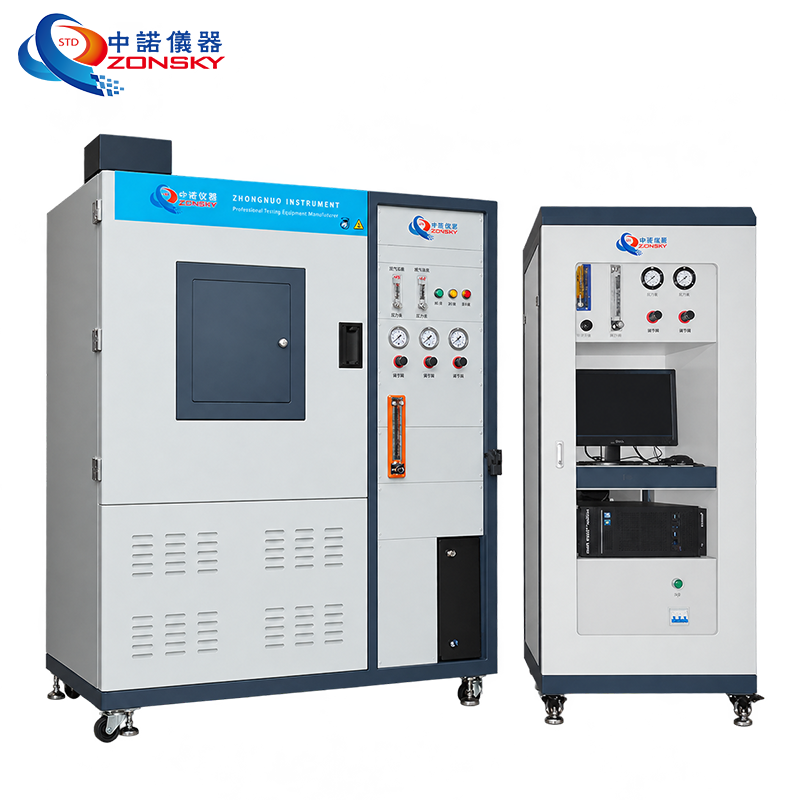
The ZY6282B FTIR Fourier Smoke Toxic Gas Analyser from ZONSKY is designed for analysing gaseous combustion products in fire testing applications.
Using FTIR spectroscopy, the instrument supports the investigation of toxic gas composition and concentration changes during combustion experiments.
It is applicable to research involving cable materials, polymers, railway components, and other products requiring fire effluent analysis.
When integrated with suitable sampling equipment and validated testing procedures, the ZY6282B can support laboratories conducting fire toxicity research and material safety evaluations.
Conclusion
As fire safety requirements evolve, understanding the chemical composition of combustion gases is becoming increasingly important.
ISO 19702:2024 provides a technical foundation for FTIR-based fire gas analysis, while standards such as EN 45545-2 and the IMO FTP Code demonstrate its relevance across different industries.
The ZY6282B FTIR Gas Analyser offers laboratories a practical approach to investigating toxic combustion gases and improving the depth of fire safety assessments.