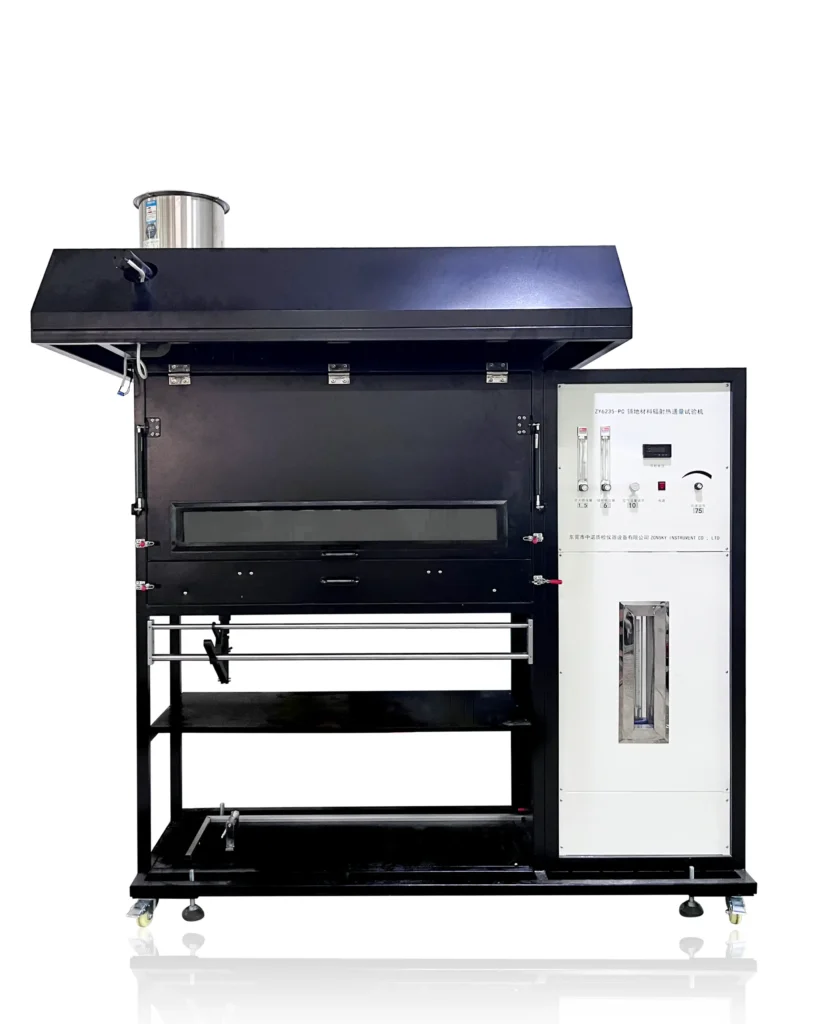
Inside the enclosed cabin at tens of thousands of feet, the spread of fire is often measured in seconds. When discussing the flame retardancy of aviation interior materials, traditional metrics such as “ignitability” or “self-extinguishing” can no longer meet the stringent requirements of modern aviation safety. What truly determines passenger survival is the speed and total volume of heat released by the material in a blaze. As the core equipment for global airworthiness certification of aviation materials, The Heat Release Rate From Cabin Materials Exposed to Radiant Heat (compliant with ASTM E906/E906M-17 and FAR Part 25 Appendix F, Part IV) establishes an insurmountable “life-or-death scale” for aviation safety through two core parameters: Peak Heat Release Rate (Peak HRR) and 2-minute Total Heat Release (2-min THR).
Peak HRR: The Ultimate Defense Line Against Flashover
Peak Heat Release Rate (Peak HRR) refers to the maximum instantaneous heat release power reached by a material within the first 2 minutes of combustion. During OSU testing, the material is subjected to extreme thermal radiation of 35 kW/m², which accurately simulates the extreme conditions where surrounding interior materials are rapidly heated and burn violently after a localized cabin fire. Peak HRR is the most intuitive indicator of fire intensity. If the peak heat release rate is too high, it means heat will accumulate rapidly in a very short time, easily triggering a catastrophic “flashover” phenomenon within the enclosed cabin. Therefore, when developing new aviation composites, engineers continuously adjust flame retardant formulations using OSU equipment, with the primary goal of keeping the Peak HRR strictly below the safety threshold to secure precious golden escape time for passengers.
2-min THR: The "Energy Ruler" for Quantifying Fire Scale
If Peak HRR represents the “highest peak” of a fire outbreak, then the 2-minute Total Heat Release (2-min THR) measures the “total energy” in the early stages of the fire. Within the first 120 seconds of OSU testing, the cumulative heat released by the material is accurately recorded. This parameter reflects the overall combustion potential of the material during the initial stage of a fire. The lower the THR value, the less total thermal energy the material releases within the same timeframe, and the slower the fire spreads. For aviation interiors, controlling the 2-min THR not only effectively delays the overall temperature rise in the cabin but also significantly reduces the dense smoke and toxic gases generated by high-temperature pyrolysis, providing clearer visibility and a safer breathing environment for emergency evacuation.
Data-Driven Evolution of Aviation Materials
From the instantaneous burst control of Peak HRR to the cumulative energy limitation of 2-min THR, the OSU tester has completely ended the era of “blind trial-and-error” in aviation flame retardant material R&D with extremely stringent quantitative data. These two core parameters are not only rigid indicators of global airworthiness standards such as Boeing (BSS 7322), Airbus (AITM 2.0006), and CAAC CCAR-25-R4, but also prerequisites for materials to obtain the “blue sky pass.” In today’s pursuit of ultimate lightweight design and high flame retardancy, the OSU tester is not only a compliance testing device but also a “safety microscope” in the hands of aviation material engineers. By accurately capturing minute changes in Peak HRR and 2-min THR, it guides the continuous evolution of aviation interior materials towards lower smoke, lower toxicity, and lower heat release, silently safeguarding the safety of every takeoff and landing.