
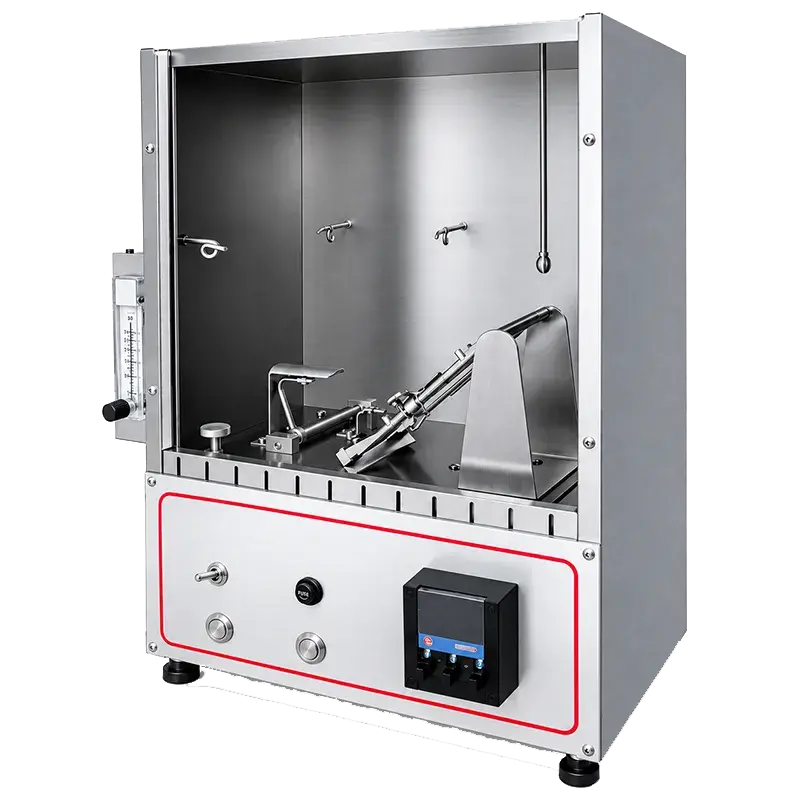
ZY6209 45° Angle Combustion Tester for Railway Vehicle Materials
Highlights
1. Designed for Railway Vehicle Materials
Purpose-built for evaluating the flame-retardant performance of materials used in locomotives and railway vehicles.
2. Compliance with TB/T 3138-2018
Designed to meet the test requirements specified in TB/T 3138-2018 and Appendix A.
3. Standard 45° Specimen Orientation
The specimen holder maintains the test specimen at a 45° inclination for standardized combustion testing.
4. Controlled Ethanol Ignition Source
Uses 0.5 mL of anhydrous ethanol in a dedicated stainless-steel combustion container as the ignition source.
5. Defined Flame Source Positioning
The vertical distance from the center of the fuel container bottom to the center of the specimen is precisely specified as 25.4 mm.
6. Dedicated Combustion Test Chamber
The test chamber provides an enclosed and controlled space for observing material combustion behavior.
7. Heat-Resistant Transparent Observation Door
The front observation door is made of heat-resistant transparent material, allowing the operator to observe ignition, flame, smoke, afterglow, and other combustion phenomena.
8. Standardized Specimen Clamping System
The specimen clamp consists of two 2.0 mm thick L-shaped steel plates with an inner frame size of 182 × 257 mm, providing stable specimen positioning during testing.
9. Integrated Smoke Exhaust Fan
A top-mounted exhaust fan facilitates smoke removal after completion of the test. The fan remains switched off during the combustion test.
10. Multiple Combustion Characteristics Evaluated
The test method enables observation and evaluation of ignition, flame generation, smoke condition, flame behavior, residual flame, afterglow, charring, and deformation.
Method
1. Specimen Installation
Secure the specimen between the two steel plates of the specimen clamp and fasten both sides with clips.
Place the specimen assembly on the test frame so that the specimen is maintained at an inclination of 45°.
2. Prepare the Combustion Source
Add 0.5 mL of anhydrous ethanol to the stainless-steel combustion container.
The combustion container is positioned so that the vertical distance from the center of the bottom of the fuel container to the center of the specimen is 25.4 mm.
3. Ignition
Ignite the anhydrous ethanol and allow the fuel to burn until it is completely consumed.
4. Observation During Ethanol Combustion
During combustion of the ethanol, observe the specimen for characteristics including:
Whether the specimen ignites
Formation of flames
Smoke generation
Flame condition and behavior
5. Observation After Combustion
After the ethanol has completely burned, inspect the specimen for:
Residual flame
Afterglow
Charring
Deformation
6. Evaluation
The detailed evaluation criteria are specified in Table A.1 of Appendix A of TB/T 3138-2018.
Materials exhibiting abnormal smoke generation may be downgraded by one grade during evaluation.
When both specimens meet the requirements, the product is considered compliant. If one specimen fails, the test shall be repeated using twice the number of specimens. The product is considered compliant only when all specimens in the repeated test meet the specified requirements.
Specifications
| Component | Configuration |
|---|---|
| Model | ZY6209 |
| Test System | 45° angle combustion test system for railway vehicle materials |
| Applicable Standard | TB/T 3138-2018, including Appendix A |
| Main Components | Combustion test chamber, test frame, and combustion container |
| Test Chamber Internal Dimensions | 370 mm (W) × 220 mm (D) × 360 mm (H) |
| Chamber Dimension Tolerance | ±10 mm |
| Specimen Inclination Angle | 45° |
| Specimen Clamp Material | Steel plates bent into an L-shaped profile |
| Specimen Clamp Plate Thickness | 2.0 mm |
| Specimen Clamp Inner Frame Size | 182 mm × 257 mm |
| Combustion Container Material | Stainless steel |
| Combustion Container Diameter | 17.5 mm |
| Combustion Container Height | 7.1 mm |
| Combustion Container Thickness | 0.8 mm |
| Combustion Fuel | Anhydrous ethanol |
| Fuel Volume | 0.5 mL |
| Fuel Container-to-Specimen Distance | 25.4 mm vertical distance from the center of the container bottom to the specimen center |
| Ventilation Holes | 11 or 12 evenly arranged holes at the rear section of the chamber top |
| Ventilation Hole Diameter | 12.7 mm |
| Observation Door | Heat-resistant transparent material |
| Smoke Exhaust System | Top-mounted exhaust fan; operated after the test is completed |
| Instrument Weight | Approx. 25 kg |
| Overall Dimensions (L × W × H) | Approx. 570 mm × 400 mm × 1100 mm |
| Optional / Excluded Equipment | Top exhaust duct and smoke purification system are not included |
Consultancy & Sales
Do you have further questions about the instrument or the method and would like to speak to a sales representative?
Service & Support
Do you already have an instrument and need technical support or spare parts?